
Author: Jason Waechter | Date: January 27, 2026 | Category: Motorcycle Accident Injuries, Motorcycle Laws, Uncategorized
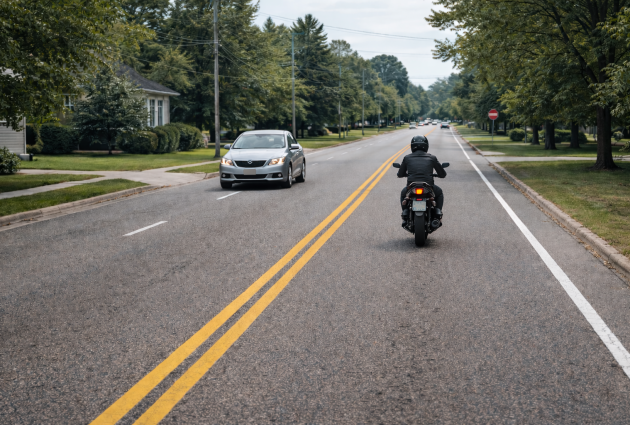
After many motorcycle accidents in Michigan, injured riders hear the same statement:
“I didn’t see the motorcycle.”
This phrase is common in left-turn collisions, intersection crashes, and lane-change accidents. But under Michigan law, failing to see a motorcyclist is not automatically a defense.
If a driver claims they didn’t see you before the crash, call 248-355-4701 for a free consultation. We represent injured motorcyclists throughout Michigan.
No.
Drivers have a legal duty to maintain proper lookout and operate their vehicles with reasonable care. The failure to observe what was there to be seen may constitute negligence.
Under Michigan negligence law, a driver who turns left, changes lanes, or enters an intersection must ensure the maneuver can be completed safely.
The inability to see a motorcycle does not eliminate that duty.
Under MCL 257.650, drivers turning left must yield the right-of-way to oncoming traffic that is approaching so closely as to constitute an immediate hazard.
Motorcycles are legally entitled to the same lane rights and protections as passenger vehicles.
If a driver turns left in front of a motorcyclist and claims they “didn’t see” the bike, the legal question becomes whether they exercised reasonable care before turning.
Motorcycles are smaller than passenger vehicles. Drivers sometimes misjudge speed, distance, or fail to scan carefully before turning.
However, courts and juries evaluate whether the driver:
“I didn’t see it” often raises more questions than it answers.
In some crashes, drivers claim they looked but did not perceive the motorcycle. This phenomenon is sometimes described as “looked-but-failed-to-see.”
Even when a driver claims they scanned the roadway, the law still requires reasonable observation under the circumstances. A failure to properly perceive visible traffic may still constitute negligence.
Insurance companies sometimes argue that the motorcycle was traveling too fast to be seen or judged accurately.
Speed may be considered when allocating comparative fault. However, the presence of speed does not automatically excuse a driver’s duty to yield when making a left turn or lane change.
Each case depends on evidence, including crash reconstruction, vehicle damage analysis, skid marks, and witness testimony.
When a driver claims they did not see the motorcycle, investigators and juries may examine:
Objective evidence often determines whether the motorcycle was visible and whether the driver had sufficient time to react.
Michigan follows a modified comparative fault system under MCL 600.2959.
If both the driver and the motorcyclist contributed to the crash, a jury may assign fault percentages to each party. As long as a rider is 50% or less at fault, recovery of non-economic damages may still be available (subject to reduction).
Being partially at fault does not automatically eliminate a claim.
Even when a driver’s negligence is clear, an injured motorcyclist must still meet Michigan’s serious impairment threshold under MCL 500.3135 to recover pain and suffering damages.
Fault and injury severity are separate legal requirements.
Visibility arguments often hinge on technical details. Skid marks fade. Surveillance footage is erased. Vehicle data can be lost.
Preserving evidence early may significantly impact how fault is allocated.
If a driver claims they didn’t see your motorcycle, do not assume you have no case. Call 248-355-4701 for a free consultation. We represent riders across Detroit, Grand Rapids, Lansing, Flint, Ann Arbor, and throughout Michigan.
No. Drivers have a duty to maintain proper lookout and yield when required by law.
Michigan’s comparative fault system may still allow recovery as long as your fault does not exceed 50%.
Left-turn collisions often involve a failure to yield, but each case depends on evidence and circumstances.
We represent injured motorcyclists statewide in Michigan. Call 248-355-4701 for a free consultation. You pay nothing unless we win.

Results may vary depending on your particular facts and legal circumstances.
Provide a few simple details about your injury and our team will take it from there.