

Author: Jason Waechter | Date: February 12, 2026 | Category: Insurance, Motorcycle Laws
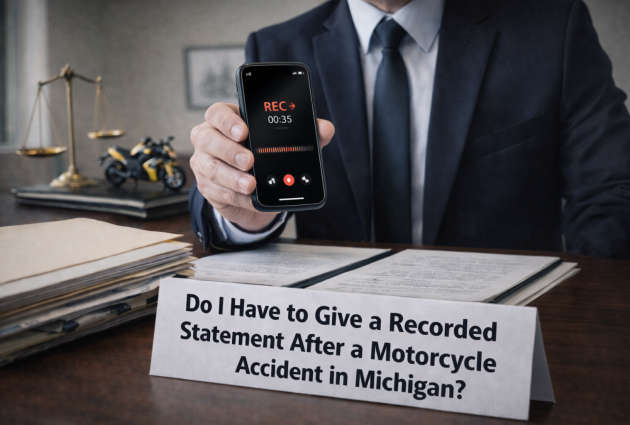
After a motorcycle crash, it often happens quickly.
An insurance adjuster calls and says:
“We just need a quick recorded statement about what happened.”
It may sound routine. It may sound harmless.
But before you agree, it’s important to understand what a recorded statement is — and how it can affect your case under Michigan law.
If you were injured in a motorcycle accident anywhere in Michigan, call 248-355-4701 for a free consultation. We represent riders statewide. “I Ride, I Get It.”
In most situations, you are not legally required to give a recorded statement to the at-fault driver’s insurance company.
The at-fault insurer does not represent you. Their duty is to protect their policyholder and limit financial exposure.
That said, certain insurance policies — particularly your own auto or motorcycle policy — may include cooperation clauses. These cooperation clauses are contractual in nature and may require reasonable cooperation in specific contexts involving your own insurer.
The key distinction is this:
If you are unsure which insurer is calling you, call 248-355-4701 before agreeing to anything. A five-minute review can prevent months of damage control later.
Understanding which insurer is calling matters.
A pre-litigation recorded statement requested by an insurance adjuster is not the same as sworn testimony in a lawsuit.
If litigation is filed, testimony is governed by the Michigan Court Rules, including depositions under MCR 2.306. Depositions occur under oath, with formal procedures and structured questioning.
A recorded statement taken before a lawsuit is typically voluntary and not court-supervised.
That difference matters.
Insurance adjusters are trained to gather information early — often before you fully understand your injuries or the full circumstances of the crash.
Recorded statements can be used to:
What feels like a casual conversation may later be compared word-for-word against medical records, police reports, deposition testimony, and other evidence.
In serious motorcycle injury cases, small phrasing differences can become defense arguments.
Adjusters often ask questions such as:
These questions may seem simple.
But early after a crash, riders often do not yet know:
Speculation — even innocent speculation — can later be characterized as inconsistency.
If your own insurer requests a statement related to No-Fault benefits or uninsured/underinsured motorist coverage, different rules may apply.
Policies often require cooperation. However:
If No-Fault benefits are involved, Michigan law permits insurers to request examinations under MCL 500.3151. While that statute addresses physical or mental examinations (IME), it illustrates that insurers have investigative tools — and those tools should be handled carefully.
Protecting your benefits and protecting your legal position are both important.
Refusing to provide a voluntary recorded statement to the at-fault driver’s insurer does not automatically harm your claim.
Insurance companies make liability determinations based on:
You are not required to strengthen the defense’s file.
However, every case is fact-specific. The correct approach depends on:
Early legal evaluation prevents unnecessary missteps.
In the first days after a crash:
Statements made too early can unintentionally minimize symptoms or lock in incomplete information.
Insurance companies begin building their defense immediately. When catastrophic injuries are involved, the first version of events can influence how fault is analyzed and how value is assessed. Early statements carry weight.
Riders deserve to speak from a position of preparation — especially when the stakes are permanent. If you have been asked to give a recorded statement, call 248-355-4701 before responding.
In high-value motorcycle cases, credibility is critical.
Inconsistent statements can be used to argue:
When catastrophic injuries are involved, precision matters.
Protecting case value begins long before settlement discussions.
Ideally, before giving any recorded statement related to a serious injury crash.
An early review can clarify:
You only get one opportunity to give your first recorded account.
If you have been asked to give a recorded statement after a Michigan motorcycle accident, call 248-355-4701 before responding. Early guidance can protect your recovery. There is no fee unless we win your case.
Generally, no. You are not obligated to provide voluntary recorded testimony to the at-fault insurer.
In many cases, yes — particularly when injuries are still being evaluated or coverage issues are unclear.
No. Depositions occur during litigation under the Michigan Court Rules and are taken under oath. Pre-suit recorded statements are typically voluntary and not court-supervised.
It does not automatically ruin your case. However, reviewing the statement early can help identify and address potential issues.
Injuries can evolve over time. Even cases that initially appear minor deserve careful consideration before recorded testimony is provided.
This article provides general information about Michigan law. Every case is fact-specific. Speaking directly with an attorney ensures advice tailored to your situation.

Results may vary depending on your particular facts and legal circumstances.
Provide a few simple details about your injury and our team will take it from there.