

Author: Jason Waechter | Date: January 29, 2026 | Category: Motorcycle Accident Injuries, Motorcycle Laws, Uncategorized
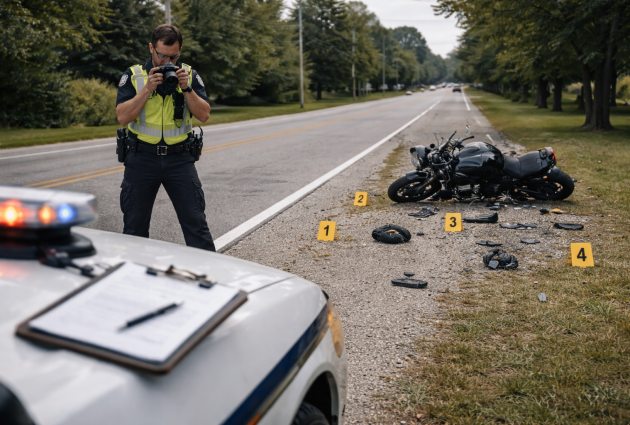
In a Michigan motorcycle accident claim, the strongest cases are not built on opinions — they’re built on proof. Insurance companies and defense teams often try to shift blame to the rider, downplay injuries, or argue that the crash “could have happened another way.” The right evidence shuts that down.
The short answer: The evidence that wins a Michigan motorcycle accident case is the evidence that proves (1) how the crash happened, (2) who was at fault, (3) how bad the injuries really are, and (4) how the injury changed your life — all in a way that’s consistent, objective, and hard to dispute.
If you were injured in a motorcycle crash anywhere in Michigan and you want your case built the right way from day one, call 248-355-4701 for a free consultation. We represent riders statewide.
Many riders assume the truth will “speak for itself.” In real claims, the outcome often depends on what can be proven and how clearly it can be shown.
Michigan cases commonly turn on:
Strong evidence doesn’t just help you win — it helps you avoid getting unfairly blamed or lowballed.
High-quality photographs and video often become the most persuasive evidence in a motorcycle crash case because they capture facts before they disappear.
Powerful visuals include:
Video sources that can be decisive:
Important: Many cameras overwrite footage quickly. If video exists, acting fast can make the difference between “case-winning” proof and nothing.
A police report provides an official baseline: who was involved, where it happened, road conditions, and what witnesses said at the scene. It can also contain diagrams, citations, and initial observations.
But a police report is not the finish line.
Police reports can be incomplete because:
A strong case uses the report as a starting point — then proves the details with independent evidence.
Independent witnesses can eliminate “he said / she said” disputes. When a driver claims “I didn’t see the motorcycle,” a neutral witness can confirm who had the right-of-way, whether the driver turned abruptly, or whether the motorcycle was plainly visible.
What wins cases is not just a name — it’s detail:
Witness memory fades. Getting the right witness information early matters.
Medical proof is what links the crash to the injuries and establishes the severity. Insurance companies often try to argue that symptoms are “minor,” “degenerative,” or “pre-existing.” Medical documentation is how you defeat those arguments.
High-value, high-authority medical evidence includes:
Consistency matters. Gaps in treatment and “downplaying” symptoms can be used against you.
Physical evidence is hard to argue with when it’s preserved and documented correctly. This includes:
Even if the motorcycle is moved, careful documentation can preserve what matters.
When liability is disputed — especially in intersection, left-turn, lane-change, or “I didn’t see the motorcycle” cases — technical analysis can be the difference between a low offer and a serious case value.
Crash reconstruction may evaluate:
A strong case doesn’t rely on stereotypes about riders. It uses measurable facts.
Distracted driving is a common hidden cause of motorcycle crashes. Drivers who “didn’t see” a motorcycle may have been looking down, not scanning.
Digital evidence can include:
These cases often turn on early preservation, because data can be lost or overwritten.
Winning the liability fight is only part of the case. The other part is proving the real cost of what happened.
Evidence that increases claim value includes:
In Michigan, pain and suffering damages often require meeting the serious impairment standard under MCL 500.3135. Proving life impact helps establish that threshold and supports the value of the case.
Motorcyclists are sometimes unfairly blamed after collisions. A strong evidence plan anticipates common defense arguments and neutralizes them:
| Defense Argument | Evidence That Counters It |
|---|---|
| “I didn’t see the motorcycle.” | Video, sightline analysis, witness statements, scene photos |
| “The rider was speeding.” | Reconstruction, damage analysis, timing/signal sequencing, credible witnesses |
| “The injuries aren’t that serious.” | Imaging, specialist records, therapy notes, work restrictions, surgical reports |
| “It was a pre-existing condition.” | Prior baseline records, post-crash imaging, objective change in function |
Even if you have time to file a lawsuit, waiting can weaken proof:
If you were injured in a motorcycle accident anywhere in Michigan, call 248-355-4701 for a free consultation. We represent riders throughout the entire state.
Video and scene photos are often the most decisive for proving how the crash happened. Medical records and imaging are critical for proving injury severity and long-term impact.
A police report helps, but it is not the only path to proof. Many strong cases are built through video, witness statements, medical records, and reconstruction evidence.
Michigan uses comparative fault rules, so evidence matters. The goal is to prove what happened with objective proof, not assumptions. Strong evidence can prevent unfair blame and protect the value of your claim.
As soon as possible. Camera footage can be erased, witness memories fade, and vehicles get repaired. Early action often strengthens liability proof and increases settlement leverage.
If you were injured in a Michigan motorcycle accident and want your case built with the evidence that wins, call 248-355-4701 for a free consultation. You pay nothing unless we win.

Results may vary depending on your particular facts and legal circumstances.
Provide a few simple details about your injury and our team will take it from there.